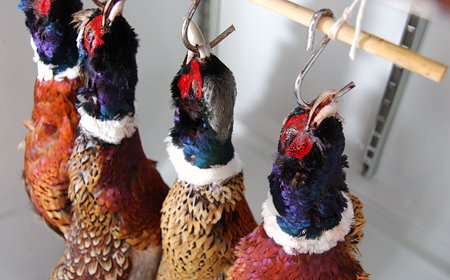
Hanging
The real purpose of hanging game is to enable the fibres of the flesh to break down and decompose so that the meat will be more tender. It is very difficult to give exact times as it depends entirely on personal taste. Some prefer slightly tougher meat with a fresh taste, while others enjoy very tender meat with a decidedly 'high' smell and flavour. These times therefore are only very approximate, and are for average seasonable temperatures. If the weather is hotter than average, hang for the shortest length of time given, and if colder than usual, for the longest. The older the game, the longer it must hang. Birds are ready for cooking when the tail, inside leg, or breast feathers can be plucked out easily. Game birds are always hung by the neck (although some say you should hang a pheasant by its feet, until the body drops!). Overhung flesh will have blueish patches on it. Game should always be hung in a shaded place in a current of air, well out of the reach of cats, dogs or foxes.
Partridge: 5-12 days
Pheasant: 3 days to 2 weeks
Grouse: 3-10 days
Blackcock: 3-4 days
Ptarmigan: 3-4 days
Capercaillie: Bury it in the ground for a few days, or hang it until it is really tender.
Pigeon: 2-3 days
Quail: Can be eaten straight away, or hung for up to 2 days
Woodcock
And Snipe: Can be eaten straight away, or kept for up to 6 days, but remember that woodcock and snipe are often cooked with the entrails left in them, so They shouldn't be left too long.
Wild Duck
(Mallard, Teal,
Widgeon, etc): can be eaten straight away, or hung up to 2 days. If left any longer the flesh is liable to turn rank.
Wild Goose: 1-2 days
Hare: About 1 week without paunching, a little longer in cold weather. Suspend it by the hind feet with a bucket under the nose to catch the blood, which makes good gravy.
Rabbit: Eat straight away, with no hanging.
Venison: 3 days to 2 weeks. There is a great deal of difference between these times, but apart from taste, it depends on many factors. A young roe deer in perfect condition will only need about 3 days, while a tough old fallow or red deer could need a good 2 weeks to make it tender.
For the average taste, test the hung meat every day by running a skewer into the haunch.So long as the skewer has no unpleasant smell when withdrawn the meat is in good condition, but if it does get rather too "high", wash it in warm water and dry it well before cooking.
If there is no fly-free larder available, rub the carcase with a mixture of flour, powdered ginger, and pepper. The furrow of the backbone should be well dressed with pepper. Wrap the carcase in muslin before hanging in the larder, but inspect it every day and give it a fresh coating of flour and ginger when necessary. Wipe with a cloth to remove any moisture which may have formed.
http://www.thehuntinglife.com/forums/index.php?showtopic=24462
...............................
By looking into the tradition of hanging game and referencing my experiments with this process, it mirrors what I intend to achieve with my muslin experiments. i feel as though the experiments with muslin will gradually mature and dry up in a similar way to the meat when getting more tender as time passes.

 I have been experimenting with Straining various plants, vegetables, and things which have been traditionally used for dyes. By using muslin, this strains the mixture/dye gradually. This process highligts the theme of time, growth, staining and traditions.